

Pueblo Mission – A Watercolor Exploration of Faith, Texture, and Place
Price range: $69 through $1,019

“‘Pueblo Mission’ marks a turning point in my watercolor journey, where observation gave way to interpretation. Inspired by a historic New Mexico mission, this piece explores texture, artistic license, and the early experimentation that helped define my emerging visual voice.
Choose Your Art Format

Luminous Metal Print

Canvas Gallery Wrap
Luxury Float Frame

Gift Art Photo-Plaque
Giclée Art Print
Limited Edition
Hand-Embellished Giclée
Pueblo Mission: From Photograph to Personal Interpretation
While traveling through New Mexico during one of our early Southwest trips, my wife and I passed through the area near San Doval, where I photographed a historic mission church. The original structure was painted white, modest and quiet against the desert landscape. I knew immediately it would become a watercolor.
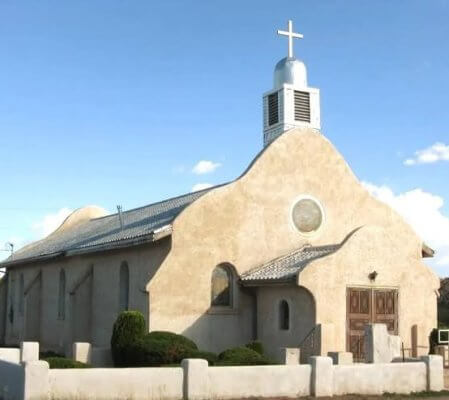
Reference photograph of the white mission that became the foundation for the Pueblo Mission
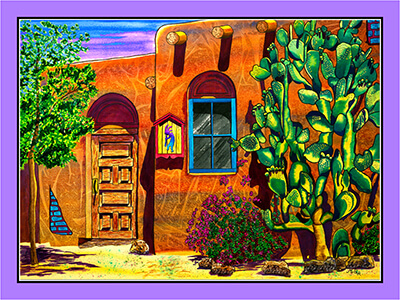
Back home in New Jersey, I didn’t aim to make an exact copy of the photograph. Instead, I used it as a starting point for Pueblo Mission—allowing watercolor art to interpret rather than simply record. The overall shape stayed the same, but the color, mood, and environment became my own.
Learning to Create Texture and Atmosphere
During this period, I studied with artist Skip Lawrence, where I learned how to create stucco-like textures by applying kosher salt directly into wet pigment. That technique became central to “Pueblo Mission.” As the salt interacted with the watercolor, it formed organic patterns that resembled the rough adobe surfaces of the mission itself.
This process taught me something vital: watercolor can be both delicate and architectural. That realization influenced many of my Sedona watercolor paintings that followed, including “San Miguel Mission” and later pueblo-inspired works.
The Birth of Variations and Multiple Versions
I liked the image of “Pueblo Mission” so much that it became the basis for several variations. Instead of repainting the whole structure each time, I experimented by making separate watercolor backgrounds on individual sheets of paper.
Those backgrounds of Pueblo Mission were scanned and carefully inserted behind the mission, enabling each version to convey a different emotional tone while maintaining the original architectural structure. This process resulted in works like “Sandoval Snow,” where the mission is set against a snowy, brightly colored landscape, and “San Ysidro,” where warm yellows and oranges direct the viewer’s attention straight to the cross.
This same approach later influenced works like “Navajo Palapa” and “Transient Sky,” reinforcing a method I would keep returning to—one based on exploration and curiosity.
McKnight Clouds and Artistic Identity
In some variations of Pueblo Mission, you’ll notice stylized clouds drifting across the sky—what I call McKnight clouds, inspired by the bold color palette of artist Thomas McKnight. That influence not only shaped my skies but also inspired my artist name, “McShep,” merging the “Mc” from McKnight with my old Army nickname, “Shep.” It’s how I’ve signed my art ever since.
Other versions intentionally omit those clouds, allowing the sky to stay open and quiet, focusing attention on the cross and the faithful presence it symbolizes. This early exploration of sky and restraint later influenced my vivid, mystical landscapes, where atmosphere became a vital emotional element.
An Early Turning Point
“Pueblo Mission” signifies a key turning point in my journey as an emerging artist. It shifted from simply painting what I saw to making intentional choices, trusting my instincts, and letting watercolor influence the outcome. Created during the same New Jersey period as “Monday’s” and “San Miguel Mission,” this piece helped shape my voice long before I ever moved west.
The Heart of It All
Art lights up the same part of your brain as
falling in love—it’s an unforgettable feeling.
Collector’s Note
My work is also featured at the Village Gallery in Sedona—a Sedona art gallery devoted exclusively to hand-made artwork by local artists, and widely regarded as the true heart of Sedona’s local art scene. You can also find my work at Creative Gateways, a contemporary Sedona gallery that offers a welcoming mix of fine art and jewelry across a range of price points, as well as at Desert Valley Gallery in Las Vegas at Tivoli Village, where creativity, beauty, and craftsmanship come together in a unique and inspiring setting.
